
Metal Laser Cutting Service: Precision, Materials, and Practical Tolerances
Finding a metal laser cutting service that fits your material, tolerance, quantity, and project requirements should not require calling five vendors. Signage agencies need clean stainless letters. Product teams need prototype brackets. Manufacturers need repeatable flat parts for assemblies.
GYMTL provides metal laser cutting for commercial, industrial, and prototype projects. The service supports common sheet metals, practical laser-cut tolerances, and project-based quoting.
This page explains what to expect from a custom metal laser cutting partner: cutting technology, materials, tolerances, applications, quality checks, and value-added services that turn flat parts into finished components.
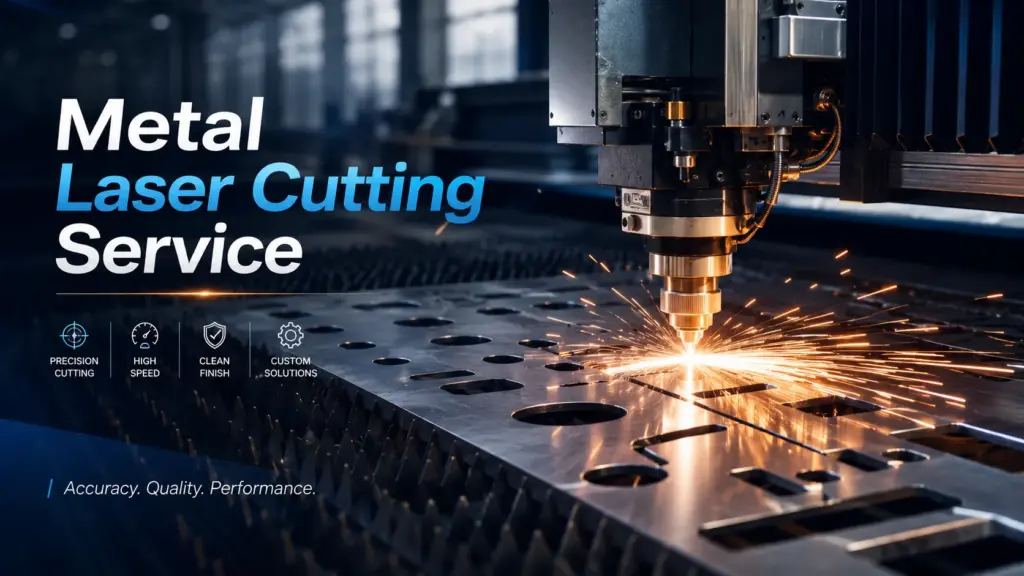
How Metal Laser Cutting Works
Fiber lasers are widely used for sheet metal cutting because they deliver high cutting speed, strong energy efficiency, and stable performance on many reflective metals. They are especially effective on thin sheet metal, stainless steel, aluminum, copper, and brass when the machine, gas, and cutting parameters are configured correctly.
A focused laser beam melts and, in some cases, vaporizes a narrow path through the metal. Assist gas removes molten material from the kerf. Nitrogen is commonly used for clean stainless steel, aluminum, and titanium edges. Oxygen is commonly used for faster carbon steel cutting because it supports an exothermic reaction at the cut edge.
Fiber laser cutting usually produces a narrow kerf and a small heat-affected zone. The exact kerf width and heat-affected zone depend on material type, material thickness, assist gas, laser power, cutting speed, and edge-quality requirements.
Fiber lasers usually outperform CO2 lasers on thin sheet metal, especially in lower thickness ranges. For thicker plate, non-metal cutting, or special edge-finish requirements, the best process depends on the material, thickness, required edge quality, and available machine power.
Metals and Thicknesses Commonly Supported
Most metal laser cutting projects use standard sheet and plate materials. The available thickness range depends on material grade, laser power, assist gas, edge-quality requirements, and current stock.
Material | Common Grades | Typical Cuttable Thickness Range |
Mild / Carbon Steel | A36, S235, S275 | 0.5 mm to 25 mm |
Stainless Steel | 304, 316 | 0.5 mm to 20 mm |
Aluminum | 5052, 6061 | 0.5 mm to 12 mm |
Copper | C1100, C1010 | 0.5 mm to 6 mm |
Brass | C260 | 0.5 mm to 6 mm |
Galvanized Steel | G60, G90 | 0.5 mm to 10 mm |
Spring Steel | 1075, 1095 | 0.5 mm to 5 mm |
These ranges describe common laser cutting capabilities, not a blanket guarantee for every part. Final manufacturability depends on the material certificate, sheet thickness, geometry, hole size, edge-quality requirement, and production quantity.
Copper, brass, and aluminum reflect more beam energy than many steels. Fiber laser systems are commonly used for these metals, but the project still requires the right machine protection, assist gas, cutting parameters, and edge-quality expectations.
If your material is not listed, send a spec sheet with the file. The project can then be reviewed to confirm whether laser cutting is the right process or whether waterjet, plasma, machining, or another process is more suitable.
Precision Tolerances You Can Specify
Laser cutting is precise, but tolerance depends on material type, sheet thickness, part size, heat input, feature geometry, and inspection method. Over-specifying tight tolerances can raise part cost without improving how the part functions.
For many sheet metal parts, a practical standard tolerance is about ±0.005″ to ±0.010″ (±0.127 mm to ±0.254 mm). Tighter tolerances may be possible on selected features after engineering review.
Sheet Thickness | Practical Tolerance Guidance |
Under 1.5 mm | ±0.10 mm to ±0.15 mm; tighter features may be reviewed case by case |
1.5 mm to 5 mm | ±0.15 mm to ±0.25 mm |
5 mm to 10 mm | ±0.20 mm to ±0.35 mm |
Over 10 mm | ±0.30 mm to ±0.50 mm or wider, depending on material and geometry |
The pattern comes from physics, not only equipment quality. Beam behavior, thermal input, taper, material movement, and edge condition all become harder to control as thickness increases.
Use tight callouts only for mating holes, locating tabs, press-fit features, assembly-critical edges, or inspection-critical datums. General outside profiles usually do not need the tightest tolerance.
Features that need routine ±0.001″ accuracy are usually better suited for CNC machining after laser cutting. Laser cutting can produce the blank, and machining can finish the precision surfaces, bores, or datum features.
Laser cutting creates a heat-affected zone along the cut edge. This zone is usually narrow, but it can matter for press-fit features, weld preparation, cosmetic surfaces, and secondary forming.
Industries We Serve and What We Cut for Them
A laser cutting service can support production parts, commercial fabrication, and early-stage prototypes. The cutting process is similar across project types, but the quoting, inspection, documentation, and finishing requirements change by application.
Industrial OEM and Production
Manufacturers use laser-cut metal parts for brackets, panels, guards, housings, mounting plates, heat shields, machine covers, and flat components for welded or formed assemblies. Production work focuses on repeatability, clean edges, drawing control, and predictable communication.
Commercial and Architectural Fabrication
Signage companies, architects, interior designers, and event fabricators use laser cutting when the cut edge is part of the finished appearance. Typical work includes signage letters, decorative panels, perforated sheets, display hardware, custom brackets, and architectural details.
Stainless steel, brushed aluminum, copper, and brass are common materials for visual applications. Cosmetic edge quality means low dross, controlled oxidation, minimal discoloration, and a narrow heat-affected zone.
R&D and Rapid Prototyping
Product teams, university labs, and engineering groups use laser cutting for first-article enclosures, mounting plates, sensor brackets, test fixtures, electronics housings, and sheet metal prototypes. Prototype work usually focuses on fit, function, design validation, and quick iteration before production.
If your application does not fit these categories, send the file and material requirements for review.
File Preparation for a Laser Cutting Quote
A clear file helps the shop review the part, confirm manufacturability, and quote the project accurately.
DXF is preferred for 2D flat parts. DWG, AI, and EPS can also be used for 2D geometry. STEP or STP files are useful when the part has bends, formed features, or assembly context.
Before you submit the file, scale it to 1:1, specify units, remove duplicate lines, remove construction geometry, and convert text to outlines when the text is part of the cut shape.
A complete request should include material type, material grade, sheet thickness, quantity, finish requirements, critical tolerances, inspection needs, and any secondary operations such as bending, welding, deburring, or coating.
Quality Checks and Documentation
Quality control starts with the drawing, material, and tolerance requirements in the quote. Each project is reviewed for manufacturability before production begins.
For production jobs, parts can be checked with standard inspection tools such as calipers, micrometers, gauges, and visual edge inspection. Inspection scope depends on the drawing requirements, part quantity, tolerance level, and agreed project requirements.
Material documentation may be available when requested before quoting, depending on the material source and supplier documentation. Projects that require certified traceability, regulated-industry documentation, export-controlled handling, or formal quality-system certification must be reviewed before acceptance.
Value-Added Services for End-to-End Delivery
Many laser-cut parts need more than cutting. Bending, welding, deburring, finishing, and hardware insertion can turn a flat blank into a usable component.
Post-cut services may include CNC press brake bending for brackets, enclosures, panels, and chassis; welding and assembly for sub-assemblies; deburring and edge finishing for safer handling; surface finishing such as powder coating, anodizing, plating, or painting through coordinated partners; and hardware insertion for PEM nuts, studs, or standoffs.
Availability depends on the part design, material, quantity, finish requirement, and partner capacity. The full scope should be confirmed during quoting before production begins.
Frequently Asked Questions
What is the standard tolerance for laser-cut metal parts?
A practical standard tolerance for many laser-cut sheet metal parts is about ±0.005″ to ±0.010″ (±0.127 mm to ±0.254 mm). Tighter tolerances may be possible on selected features after review. Thick materials, small holes, heat-sensitive geometries, and cosmetic edges can require wider tolerances.
What file formats are used for laser cutting quotes?
DXF is preferred for 2D flat parts. DWG, AI, and EPS can also be used for 2D geometry. STEP or STP files are useful when the part includes bends, formed features, or assembly context. Files should be submitted at 1:1 scale with clear units.
What metals can be laser cut?
Common laser-cut metals include mild steel, carbon steel, stainless steel, aluminum, copper, brass, galvanized steel, and selected specialty alloys. Final availability depends on material grade, thickness, stock, part geometry, and edge-quality requirements.
Can laser cutting hold ±0.001″ tolerance?
Laser cutting is not the best default process for routine ±0.001″ tolerance. If a part needs that level of accuracy on bores, shafts, datums, or press-fit features, laser cutting can create the blank and CNC machining can finish the precision features.
When is laser cutting not the right process?
Laser cutting may not be the best process for very thick plate, extremely tight machined tolerances, special internal geometry, or parts that require a non-thermal cutting method. Waterjet, plasma, stamping, machining, or a hybrid process may be better depending on the part.
What information should be included in a quote request?
A complete quote request includes the file, material type, material grade, sheet thickness, quantity, finish requirements, critical tolerances, inspection needs, and any secondary operations such as bending, welding, deburring, coating, or hardware insertion.