
Sheet Metal Laser Cutting Service: Materials, Tolerances and Costs
A sheet metal laser cutting service cuts flat metal parts from CAD files by using a focused laser beam, assist gas, and CNC motion control. The service is used for prototypes, production brackets, enclosures, panels, shims, guards, fixtures, and precision sheet metal components.
This guide covers material range, thickness capability, tolerance expectations, edge quality, heat-affected zone, quality documentation, lead time, and RFQ preparation.
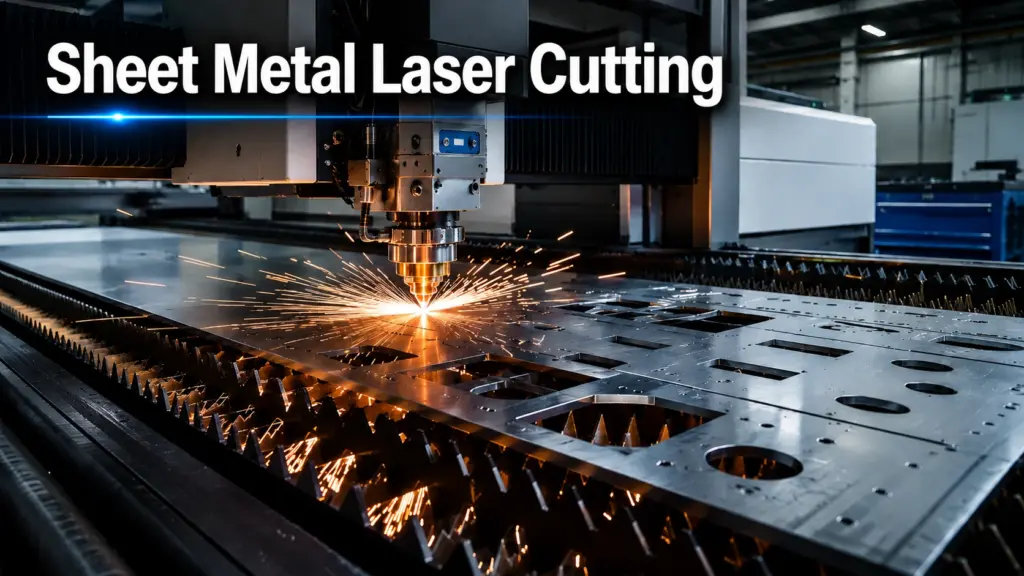
What Does a Sheet Metal Laser Cutting Service Do?
A sheet metal laser cutting service converts 2D or 3D design files into flat metal parts. The supplier programs the cut path, selects the cutting parameters, nests parts on sheet stock, cuts the material, removes parts from the skeleton, and performs required secondary operations.
Common secondary operations include:
- Deburring
- Tapping
- Countersinking
- Forming
- Welding
- Hardware insertion
- Powder coating
- Plating
- Anodizing
- Passivation
- Dimensional inspection
Laser cutting is suitable for parts that need accurate profiles, clean edges, repeatable geometry, and short setup time. It is often faster than tooling-based processes for prototypes, low-volume production, and design revisions.
What Materials Can Be Laser Cut?
Sheet metal laser cutting services commonly cut carbon steel, stainless steel, aluminum, galvanized steel, copper, brass, and selected specialty alloys. Actual material capability depends on laser power, machine condition, assist gas, material surface condition, and thickness.
Common laser-cut materials include:
Material Category | Common Examples | Procurement Notes |
Carbon steel | Mild steel, cold-rolled steel, hot-rolled steel | Often cut with oxygen or nitrogen depending on edge requirements |
Stainless steel | 304, 316, 430 | Nitrogen cutting can reduce oxidation and improve edge appearance |
Aluminum | 5052, 6061 | Reflectivity and thermal conductivity affect cut quality |
Galvanized steel | Galvanized, galvannealed | Zinc coating can affect fumes, edge quality, and welding preparation |
Copper and brass | C110 copper, cartridge brass | Reflective materials require suitable fiber laser capability |
Specialty alloys | Titanium, Inconel, Hastelloy, nitinol | Supplier review is required before quoting |
A supplier should confirm material grade, thickness, sheet size, grain direction, and finish requirements before production.
How Thick Can Sheet Metal Laser Cutting Go?
Laser cutting thickness depends on laser power, machine design, gas system, optics, material type, and the required edge quality. Modern fiber laser systems can cut thin sheet efficiently and can also process thicker plate, but maximum thickness is not the same as production-ready thickness.
For procurement, the better question is not “What is your maximum thickness?” The better question is:
What thickness can you cut repeatedly while meeting my edge quality, tolerance, and inspection requirements?
A shop may be able to cut a thick plate once, but production work requires stable pierce quality, consistent kerf, controlled taper, acceptable dross, and repeatable inspection results.
Fiber Laser vs CO2 Laser for Sheet Metal
Fiber lasers are the dominant technology for industrial sheet metal cutting because they cut many metals efficiently and require less optical maintenance than traditional CO2 systems. High-power industrial fiber lasers commonly operate around the 1 µm wavelength range, while CO2 lasers operate around 10.6 µm. IPG lists high-power fiber laser wavelengths around 1007–1070 nm and energy efficiency above 40% for its high-power systems.
CO2 lasers still have value in some non-metal applications, but fiber lasers are usually preferred for production metal cutting. Fiber systems are especially common for stainless steel, mild steel, aluminum, brass, and copper when the machine is configured for reflective metals.
What Tolerance Can Laser Cutting Hold?
Laser cutting tolerance depends on material thickness, machine calibration, part geometry, heat input, assist gas, and inspection method. Thin sheet usually holds tighter tolerances than thick plate. Small holes, narrow slots, internal corners, and long thin features are harder to hold than simple outside profiles.
A practical tolerance framework is:
Feature Type | Typical Expectation |
General sheet metal profiles | Suitable for many formed, welded, and assembled parts |
Thin-gauge precision profiles | Tighter control is possible with stable material and optimized settings |
Thick plate profiles | Wider tolerance and more taper are expected |
Precision bores or dowel holes | Secondary machining is often required |
Cosmetic edges | Nitrogen cutting or finishing may be required |
Laser cutting is not a replacement for CNC machining when a feature requires very tight roundness, positional control, or bearing-fit accuracy. A common manufacturing route is to laser-cut the outside profile and then machine critical holes, slots, or mating features.
What Is the Heat-Affected Zone in Laser Cutting?
The heat-affected zone, or HAZ, is the area near the cut edge where heat changes the material without fully melting it. Laser cutting usually produces a smaller HAZ than plasma or oxyfuel cutting, but it is still a thermal process. IPG notes that laser cutting generally produces a smaller heat-affected zone than plasma cutting.
HAZ matters when the part is used in fatigue, corrosion, welding, medical, aerospace, or high-stress environments. It can affect hardness, microstructure, coating adhesion, corrosion behavior, and edge performance.
HAZ risk increases when:
- Material is thick
- Cutting speed is too slow
- Heat accumulates around small features
- Holes are too close together
- Stainless steel, titanium, or specialty alloys are used
- The part requires high fatigue performance
A supplier can reduce HAZ risk by optimizing power, speed, focus, assist gas, lead-ins, pierce strategy, and cut sequencing. Critical parts may need edge finishing, passivation, machining, or additional inspection after laser cutting.
What Lead Time Is Realistic?
Laser cutting lead time depends on file quality, material availability, quantity, part complexity, secondary operations, inspection requirements, and supplier capacity. Simple flat parts from stocked material can move quickly. Parts that need forming, welding, finishing, inspection reports, or first article documentation take longer.
Lead time is affected by:
- Material stock status
- Sheet thickness and grade
- Cut path length
- Number of pierces
- Quantity
- Deburring or edge finishing
- Forming or welding
- Coating or plating
- Required inspection level
- Required documentation
- Open engineering questions
A supplier can quote faster when the RFQ includes clean CAD files, a controlled drawing, material requirements, quantity breaks, finish requirements, tolerance requirements, and documentation requirements.
What Drives Laser Cutting Cost?
Laser cutting cost is driven by material, machine time, setup time, pierce count, path length, part quantity, nesting efficiency, and secondary operations.
The main cost drivers are:
Cost Driver | Why It Matters |
Material grade and thickness | Thicker or higher-cost metals increase material and cutting cost |
Pierce count | Each hole or internal feature adds machine time |
Cut length | Longer profiles increase laser runtime |
Quantity | Higher quantities spread setup time across more parts |
Nesting efficiency | Better nesting reduces scrap |
Edge quality | Cleaner edge requirements can slow cutting |
Secondary operations | Forming, tapping, coating, and inspection add cost |
Documentation | FAI, CMM reports, and traceability add administrative and inspection time |
A perforated panel can cost much more than a simple plate with the same outside dimensions because hundreds of holes add pierces and cutting time. A buyer can reduce cost by simplifying hole patterns, using standard material thicknesses, increasing batch quantity, and separating cosmetic requirements from functional requirements.
How to Prepare Files for a Laser Cutting Quote
A complete RFQ helps the supplier quote accurately and reduces engineering delays. DXF is commonly used for 2D laser cutting paths. STEP files are useful when the part includes bends, assemblies, countersinks, or 3D reference geometry.
A strong RFQ package includes:
- 2D DXF file for flat cut geometry
- PDF drawing with revision control
- STEP file for formed or assembled parts
- Material grade and thickness
- Quantity and annual usage
- Required tolerances
- Critical-to-quality dimensions
- Finish requirements
- Deburring requirements
- Grain direction requirements, when applicable
- Inspection report requirements
- Material certificate requirements
- FAI, PPAP, or other documentation requirements
- Delivery address and target date
Before sending a DXF, remove duplicate lines, hidden geometry, title blocks, dimensions, construction lines, and open contours. The file should contain only the geometry that needs to be cut unless the supplier requests otherwise.
Design Guidelines for Laser-Cut Sheet Metal
Laser-cut parts are easier to manufacture when the design matches the process. These rules are practical starting points, not universal limits.
Design Feature | Practical Guideline |
Small holes | Avoid holes smaller than the material thickness unless the supplier confirms capability |
Narrow slots | Keep slot width large enough for stable cutting and clean slug removal |
Thin webs | Avoid very narrow metal between adjacent cuts |
Sharp inside corners | Use small radii when stress or cracking is a concern |
Long thin parts | Expect thermal movement and handling distortion |
Bend areas | Keep holes and slots away from bend lines |
Cosmetic surfaces | Specify protective film or handling requirements |
Critical fits | Use machining after laser cutting for precision fits |
Laser cutting works best when the drawing separates functional tolerances from non-critical dimensions. Not every edge needs the same tolerance, finish, or inspection level.
FAQ
What is a sheet metal laser cutting service?
A sheet metal laser cutting service cuts flat metal parts from CAD files by using a CNC-controlled laser beam. The service is used for prototypes, production components, brackets, panels, enclosures, and precision sheet metal parts.
What materials can be laser cut?
Common laser-cut materials include mild steel, stainless steel, aluminum, galvanized steel, brass, copper, and selected specialty alloys. The supplier must confirm capability for reflective metals, coated materials, titanium, nickel alloys, and medical or aerospace alloys.
What tolerance can laser cutting hold?
Laser cutting tolerance depends on thickness, material, geometry, and machine setup. Thin sheet can usually hold tighter tolerances than thick plate. Critical bores, dowel holes, and precision fits often require CNC machining after laser cutting.
Does laser cutting create a heat-affected zone?
Laser cutting creates a heat-affected zone because it is a thermal cutting process. The HAZ is usually smaller than plasma or oxyfuel cutting, but it can still matter for fatigue, corrosion, welding, medical, and aerospace applications.
What files are best for a laser cutting quote?
DXF files are commonly used for 2D laser cutting geometry. STEP files are useful for formed parts, assemblies, and 3D references. A PDF drawing should define material, thickness, tolerances, finish, inspection, and documentation requirements.
Why do laser cutting quotes vary?
Laser cutting quotes vary because material cost, thickness, pierce count, cut length, quantity, nesting efficiency, secondary operations, inspection, and documentation requirements all affect cost. A clean RFQ reduces quote variation and prevents production delays.