
Stainless Steel Laser Cutting Service for Custom Sheet and Plate Parts
Stainless steel laser cutting service is a manufacturing process for cutting stainless steel sheet and plate into custom parts, panels, brackets, covers, enclosures, decorative components, and industrial assemblies. The process uses a focused laser beam and assist gas to cut the material according to a digital drawing.
Stainless steel is widely used because it combines corrosion resistance, strength, clean appearance, and good formability. Laser cutting is suitable for stainless steel because it can produce accurate profiles, narrow kerfs, detailed shapes, and repeatable parts without using hard tooling.
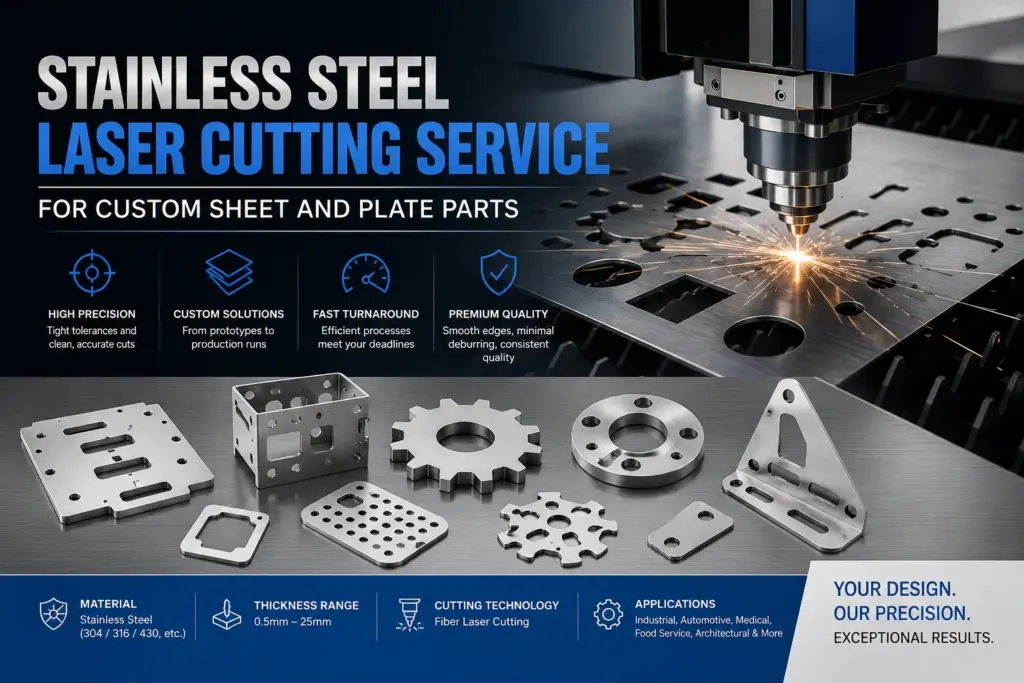
What Is Stainless Steel Laser Cutting?
Stainless steel laser cutting is a thermal cutting process. The laser beam heats the cutting path, and assist gas removes molten material from the kerf. The result is a shaped part that follows the geometry in the CAD file.
Fiber laser cutting is commonly used for stainless steel sheet and plate because fiber lasers provide high energy density and efficient processing for many metal cutting applications. The final result depends on the stainless steel grade, material thickness, surface finish, assist gas, laser power, focus position, cutting speed, and part geometry.
Laser cutting is commonly used for flat stainless steel parts before bending, welding, tapping, deburring, brushing, polishing, passivation, or assembly.
Why Stainless Steel Is Cut with Laser
Stainless steel laser cutting is used when a project requires clean edges, repeatable geometry, and efficient production from digital files. It works well for prototypes, low-volume production, and larger production runs when the part is made from sheet or plate.
The main benefits of stainless steel laser cutting include accurate profiles, flexible design changes, no dedicated cutting die, minimal mechanical force on the workpiece, and efficient nesting of parts on the sheet. Laser cutting also supports small holes, internal cutouts, slots, tabs, and complex outlines when the design follows manufacturable limits.
Laser cutting does not replace every metal cutting process. Waterjet, machining, sawing, stamping, or plasma cutting may be better for certain thicknesses, tolerances, edge requirements, materials, or budgets. A good supplier reviews the drawing before recommending the cutting method.
Stainless Steel Grades for Laser Cutting
Stainless steel laser cutting services commonly work with austenitic, ferritic, martensitic, precipitation-hardening, and duplex stainless steels. The available grades depend on the supplier’s stock, local material supply, and project requirements.
Common stainless steel grades include 304, 304L, 316, 316L, 430, 410, 420, 17-4 PH, 2205 duplex, and other project-specific alloys. 304 stainless steel is widely used for general fabrication, kitchen equipment, architectural parts, and industrial components. 316 stainless steel is used where better chloride resistance is required, such as marine, chemical, food, and medical-related environments. 430 stainless steel is used for decorative trim, appliance panels, and applications where ferritic stainless steel is acceptable.
The stainless steel grade affects corrosion resistance, magnetic behavior, strength, hardness, heat response, and finishing needs. The selected grade should match the operating environment, not only the cutting process.
Assist Gas for Stainless Steel Laser Cutting
Nitrogen is commonly used for stainless steel laser cutting when a bright, low-oxidation edge is required. Nitrogen helps remove molten material from the kerf without creating the same oxidizing reaction associated with oxygen-assisted cutting. This helps produce a cleaner edge that may require less post-processing for many visible or corrosion-sensitive applications.
Oxygen can be used in some cutting situations, but it can leave an oxidized edge. That edge may require additional cleaning, grinding, pickling, passivation, or finishing when appearance, welding quality, or corrosion resistance is important. Compressed air may also be used in some jobs, but it usually produces a different edge condition from high-purity nitrogen.
The correct assist gas depends on the part function, surface requirement, material thickness, cost target, and post-processing plan.
Tolerances and Edge Quality
Stainless steel laser cutting tolerance depends on material thickness, machine condition, cutting parameters, part size, heat input, feature geometry, and inspection method. Thin stainless steel sheet usually holds tighter profiles than thick plate. Small holes, sharp internal corners, narrow slots, and long thin features may need special review before production.
ISO 9013 can be used to define thermal cut quality, including laser cut quality, when the standard is referenced in drawings or delivery documents. The standard covers thermal cutting processes and includes laser cuts within a defined thickness range.
Dimensional tolerance and edge quality are different requirements. A part can meet profile dimensions but still need a smoother edge, less taper, reduced burr, or better surface appearance. Drawings should separate dimensional tolerance, edge condition, surface finish, burr limit, and post-processing requirements.
For critical parts, the RFQ should state which features are functional. Holes for fasteners, mating edges, bend lines, sealing surfaces, visible edges, weld edges, and assembly slots may need different tolerance or finishing requirements.
Surface Finishes for Laser Cut Stainless Steel
Stainless steel is available in several surface finishes. Common options include mill finish, brushed finish, polished finish, and mirror-like decorative finish. The finish affects appearance, handling, scratch sensitivity, protective film use, and cutting setup.
Polished or mirror stainless steel requires careful handling because the surface is easier to mark. Protective film may be used during cutting and fabrication, but film type, adhesive behavior, laser compatibility, and heat response must be checked before production.
Visible parts often need deburring, brushing, grain direction control, polishing, or protective packaging after laser cutting. Functional parts may only need burr removal and dimensional inspection.
Design Guidelines for Stainless Steel Laser Cutting
A manufacturable stainless steel laser cut part uses geometry that matches material thickness, cutting process, and final function. Internal corners should allow a realistic kerf radius. Very small holes should be reviewed against material thickness. Narrow bridges, thin tabs, and long slender features can distort during cutting, handling, or later bending.
Drawings should include material grade, thickness, quantity, surface finish, grain direction if needed, tolerance requirements, edge condition, hole requirements, bend requirements, welding requirements, and finishing requirements.
CAD files commonly used for quoting include DXF, DWG, STEP, and PDF drawings. A 2D cutting file defines the profile. A 3D file helps when the part includes bends, formed features, weldments, or assembly relationships.
Secondary Services After Laser Cutting
Stainless steel parts often require additional fabrication after cutting. Common secondary services include deburring, edge rounding, tapping, countersinking, bending, welding, brushing, polishing, passivation, electropolishing, and assembly.
Deburring removes sharp edges and loose burrs. Bending forms flat cut parts into brackets, covers, housings, and structural components. Welding joins multiple stainless steel parts into assemblies. Passivation can improve the stainless steel surface condition after fabrication when the application requires corrosion resistance in demanding environments.
Secondary processing should be planned before cutting. Bend allowance, hole placement, grain direction, edge finish, and weld access can change the best cutting layout.
How to Choose a Stainless Steel Laser Cutting Supplier
A stainless steel laser cutting supplier should be evaluated by material capability, cutting capacity, inspection process, finishing options, communication quality, and experience with similar parts.
The RFQ should ask for supported stainless steel grades, available thicknesses, accepted file formats, standard tolerance policy, edge quality options, deburring process, finishing services, inspection report availability, material traceability options, and lead time for the specific order.
Certifications can matter, but they should match the project. ISO 9001 can support general quality management. Industry-specific projects may require additional systems, documentation, or supplier approvals. A supplier without a certain certificate may still be suitable for non-regulated work, but regulated parts require confirmed documentation before production.
RFQ Checklist for Stainless Steel Laser Cutting
A complete RFQ for stainless steel laser cutting includes the part drawing, CAD file, stainless steel grade, thickness, quantity, surface finish, tolerance requirements, edge condition, secondary operations, inspection requirements, and delivery location.
The buyer should also identify the final use of the part. Decorative panels, food equipment parts, medical device components, marine brackets, machine guards, electrical enclosures, and structural plates have different requirements. The supplier can quote more accurately when the application is clear.
FAQ
What stainless steel grades can be laser cut?
Many stainless steel grades can be laser cut, including common grades such as 304, 316, 430, 410, 420, 17-4 PH, and duplex stainless steels. The exact grade availability depends on the supplier’s inventory and material sourcing.
Is nitrogen required for stainless steel laser cutting?
Nitrogen is commonly used when the project requires a clean, low-oxidation edge. Oxygen or compressed air may be used in some cases, but they can produce different edge conditions. The assist gas should match the required edge quality, corrosion performance, appearance, and cost target.
Does laser cutting stainless steel cause discoloration?
Laser cutting can cause heat tint, oxidation, burrs, or discoloration if the process parameters, assist gas, or material condition are not suitable for the project. Nitrogen cutting, correct parameters, and post-processing can reduce these issues.
Do stainless steel laser cut parts need deburring?
Many stainless steel laser cut parts need deburring, especially when the parts are handled by people, assembled with other components, painted, polished, welded, or used as visible products. The level of deburring depends on the part function and edge requirement.
Is passivation needed after laser cutting stainless steel?
Passivation may be needed when the part is used in corrosion-sensitive environments, such as food processing, marine exposure, chemical equipment, or medical-related applications. General decorative or structural parts may not require passivation if the cut edge and surface condition meet the project requirements.
What files are needed for stainless steel laser cutting?
A DXF or DWG file is commonly used for flat cutting. A STEP file is useful for bent or assembled parts. A PDF drawing should include material, thickness, tolerances, finish, quantity, and notes that are not visible in the cutting file.